First, together with the plant team, we identify which machines, connections and data flows affect the work. Then we validate the design in a pilot area and put the migration and rollback steps in writing.
Six principles we follow when working on a production network
In an OT environment, a faulty change can stop the line. That is why we work by the following six principles in every project.
Survey first, then change
No design decision is made until the inventory and flow information have been compiled from existing records and an on-site review.
Reversible steps
A configuration backup, maintenance window and written rollback procedure for every change that affects production.
Measurable acceptance
Success criteria are written down before work begins; handover is done with measurements and a signed record.
Documented handover
Diagrams, inventories, rules and procedures are handed over in a form the maintenance team can read.
Shared scope
The scope is written jointly with the production, automation and IT teams. It is agreed who responds first when a device fails, who approves changes and who keeps the records.
Clear limits
We state up front the work we do not do; where necessary, we coordinate with the right specialist.
Reference architecture
We look at the layers and boundaries together
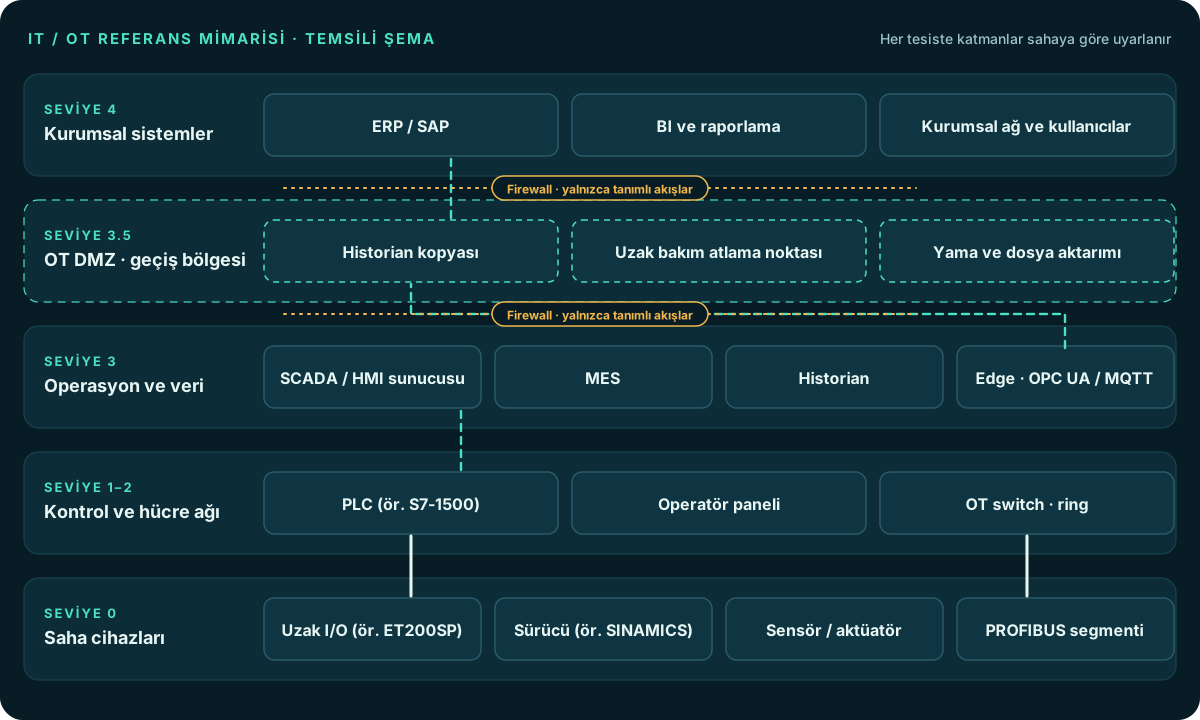
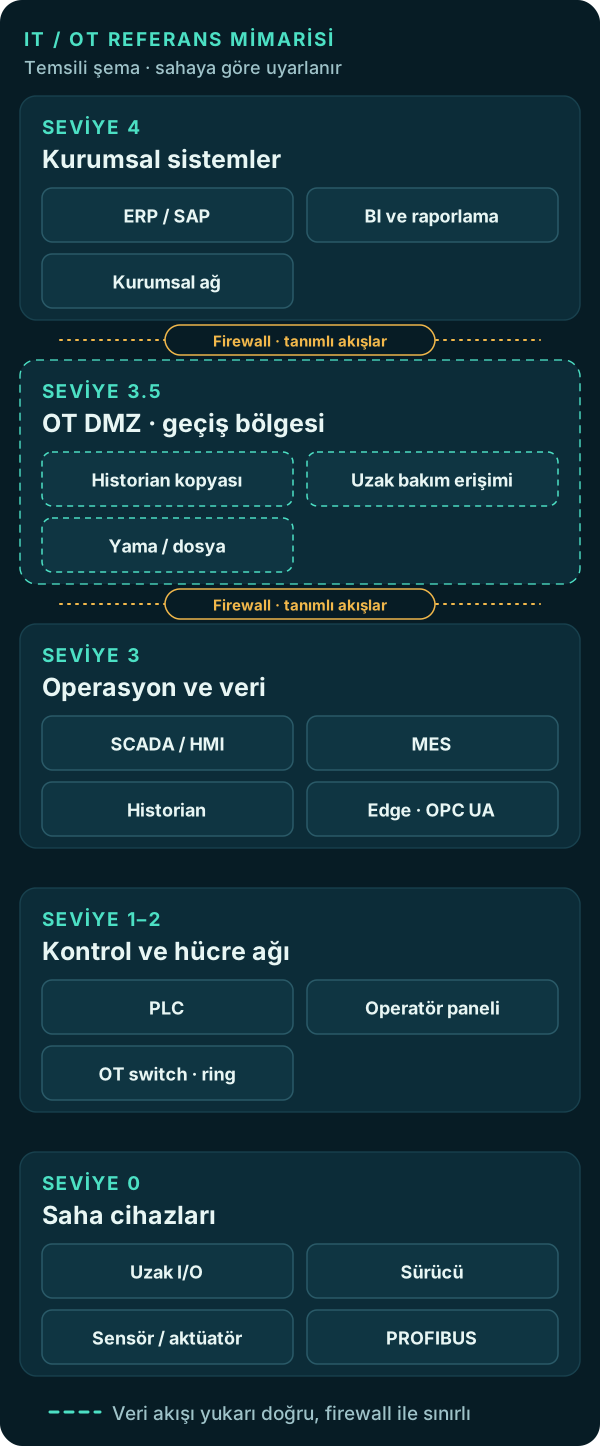
We use the Purdue model as a reference for discussing layers, and ISA-95 for describing the tasks and information exchange between production and corporate systems. Neither is a mandatory physical topology on site; we define the target architecture according to the plant’s needs.
Dashed line: data flow (OPC UA / MQTT, middleware) · Solid line: control traffic (e.g. PROFINET) · Yellow line: passage restricted by a firewall. The diagram is representative; product names are given as examples and do not imply a manufacturer partnership.
Project stages
Five stages from discovery to operation
01 / STAGE
Discovery
Interviews, on-site review, read-only device data and passive traffic observation.
02 / STAGE
Design
Topology, data flow, security boundaries and acceptance criteria.
03 / STAGE
Pilot
Implementation, measurement and feedback in one cell or line.
04 / STAGE
Implementation
A phased migration spread across downtime windows, with a rollback plan.
STAGE 05
Handover and operation
Up-to-date topology and connection documents (as-built), training, and monitoring and maintenance recommendations after implementation.
Division of responsibilities
Who does what?
The division of tasks in a typical project; it is clarified together for each project.
Topic
Eretek
Plant automation / machine manufacturer
Plant IT
Network, segmentation, OT DMZ
Design, implementation, documentation
Approval of production impact, on-site support
Corporate network and security standards
PLC data access
Data contract, integration, testing
Changes to the PLC project
Server and user management
PLC application software
Not done
Owner and responsible party
—
Machine safety / CE / SIL
Out of scope
Machine manufacturer / competent body
—
Clear limits
Project scope and responsibilities
We do not offer the following as services; when needed, we coordinate with the relevant specialist.
Writing or modifying PLC application programs
Machine CE conformity and machine safety assessment
Functional safety (SIL) calculation and verification
IEC 62443, ISO/IEC or TISAX certification and independent audits
Official reseller, service or warranty services on behalf of a manufacturer
Guarantees of results, duration or success rates
Technical survey
Let's discuss the right architecture for your production network
Let’s plan a technical survey based on your current situation, installed equipment and goals.